
HSK 3.0 Is Redefining Chinese Learning
Silk Mandarin helps you find your way into the new HSK 3.0 system.
A New Framework for Learning Chinese
HSK is moving from the familiar six-level HSK 2.0 system to HSK 3.0: a broader framework with nine levels grouped into three stages.
But HSK 3.0 is more than a new level structure. It places greater emphasis on practical communication, structured progression and the ability to use Chinese effectively in real-life situations.
For current HSK students, the key question is how their existing learning relates to HSK 3.0 and which next step best supports their goals. For new learners, it is understanding the new system and knowing where and how to start.
Through our direct involvement in the development of learning resources for the new HSK 3.0 textbook series, Silk Mandarin is bringing its experience in international Chinese teaching and Blended Learning into the new HSK 3.0 learning environment. This puts us in a strong position to help both current and new learners find their way into HSK 3.0.
What Is Changing with HSK 3.0?
HSK 3.0 reflects a broader shift in how Chinese language ability is understood, taught and assessed.
From 6 Levels to 9 Levels
The familiar six-level HSK system is being replaced by a Three Stages, Nine Levels framework.
Elementary
HSK 1–3
Everyday communication and core language skills
Intermediate
HSK 4–6
Discussing broader topics and expressing more complex ideas
Advanced
HSK 7–9
In-depth academic and professional communication, including translation
The biggest structural expansion is at the upper end. HSK 2.0 stopped at HSK 6, while HSK 3.0 introduces Levels 7–9 for learners using Chinese at a high academic or professional level.
Other Important Changes
Greater Focus on Practical Communication
What learners can actually do with Chinese becomes more central to the HSK framework. Learning requirements are connected more explicitly to communication topics and practical tasks.
Five Language Skills
HSK 3.0 covers five language skills: Listening, Speaking, Reading, Writing and — at Advanced level — Translation.
Vocabulary Is Reorganized, Expanded and Updated
Vocabulary is redistributed and expanded across the new levels, and updated to better reflect contemporary Chinese life. As a result, HSK 2.0 vocabulary does not simply map one-to-one onto HSK 3.0.
Grammar Is Also Reorganized and Expanded
Grammar is redistributed across the new levels, so learners transitioning from HSK 2.0 may need to add grammar points to meet their target HSK 3.0 requirements.
Character Recognition and Writing Are Distinguished
HSK 3.0 distinguishes more clearly between characters learners need to recognize and those they need to be able to write.
Speaking Becomes More Closely Integrated
At HSK 3–6, a corresponding HSK Speaking Test is taken alongside the written examination; at HSK 7–9, speaking is integrated into the Advanced examination. Candidates should confirm current registration arrangements for their exam date.
What Does This Mean for Current HSK Students?
If you are currently studying HSK 2.0, the most important questions are: What have I already learned, what additional knowledge might I need, and when should I move to HSK 3.0?
Everything you have learned under HSK 2.0 continues to count towards your Chinese language development, and there is no need to switch immediately.
Depending on your learning goals, you have three main options:
1. Continue learning with HSK 2.0: Keep progressing with your existing learning programme.
2. Prepare for an HSK 3.0 exam: Build on your current knowledge and prepare for the additional requirements of your target examination.
3. Move to the HSK 3.0 curriculum: Switch when suitable learning materials are available and the new curriculum fits your learning goals.
The important thing is to keep progressing in Chinese. Moving to HSK 3.0 should support that progress, not interrupt it.
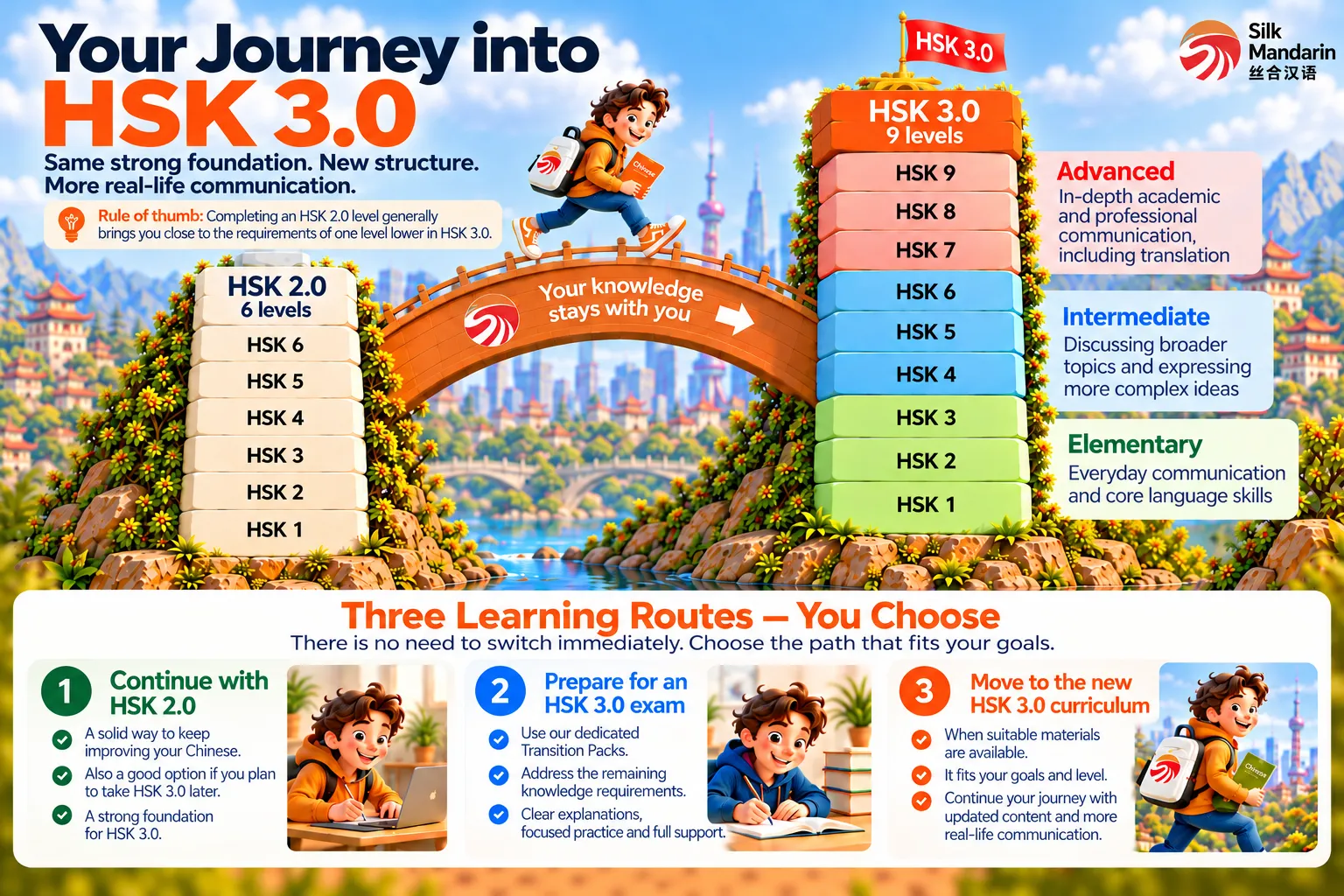
Your Journey into HSK 3.0
Explore the Guides
The first step is to understand how your completed HSK 2.0 level relates to HSK 3.0 and what additional knowledge you may need.
HSK 2.0 → HSK 3.0 Transition Guide
Our Transition Guide compares the official knowledge gaps with the smaller gaps for Silk Mandarin students, explains our Transition Packs and helps you identify the most suitable transition route.
HSK 3.0 Guide
Our HSK 3.0 Guide explains the learning requirements, communication topics and tasks, and examination arrangements for every HSK 3.0 level.
SILK MANDARIN’S CONTRIBUTION TO HSK 3.0
Silk Mandarin’s Contribution: A Modern HSK 3.0 Blended-Learning Ecosystem
From Textbook Knowledge to Practical Communication
The new HSK 3.0 textbook series provides the curriculum, content and learning progression. Through the introduction of its Blended Learning approach and the development of accompanying digital learning materials and videos, Silk Mandarin has helped transform the textbook-based course into a modern HSK 3.0 Blended-Learning ecosystem.
This new direction fits naturally with Silk Mandarin’s teaching philosophy. Our approach has always been built around a simple principle: learning Chinese is not only about acquiring knowledge, but about turning that knowledge into practical language skills. The ultimate goal is being able to use Chinese to communicate.
That same shift — from knowledge towards practical communication — is now much more clearly reflected in HSK 3.0. This close alignment made it natural to bring Silk Mandarin’s existing Blended Learning approach into the new HSK 3.0 learning resources, connecting the structure and content of the textbooks with digital learning and active classroom practice.
How Silk Mandarin’s Blended Learning Works
Our approach follows three clear steps: Preview → Class → Review.

Preview
Prepare independently
Before class, students use structured videos and digital learning materials to become familiar with vocabulary, grammar, characters and other key language points. They can learn at their own pace and arrive in class better prepared.

Class
Practise actively
Because students have already been introduced to the lesson content, more classroom time can be devoted to speaking, interaction, guided practice and personalized feedback. Knowledge is turned into active language use.

Review
Consolidate systematically
After class, structured exercises and review materials help students revisit important language points, identify gaps in understanding and strengthen retention.
This approach supports the stronger emphasis on practical communication within HSK 3.0 while giving students greater flexibility in how they prepare and review.
Want to Know More About Blended Learning?
Discover how Silk Mandarin’s Blended Learning approach works, how the three steps complement each other and why it creates more time for active communication in class.
A Smoother Transition to HSK 3.0
Silk Mandarin’s Blended Learning programme offers another important advantage for students transitioning from HSK 2.0 to HSK 3.0.
Our students learn beyond the official HSK 2.0 requirements in several areas, including additional vocabulary and character knowledge through Hack Hanzi, which forms part of our Blended Learning programme. As a result, the knowledge gap they need to bridge can be considerably smaller.
This broader preparation, combined with structured Preview, Class and Review activities, helps students build on what they have already learned and move more smoothly into HSK 3.0.
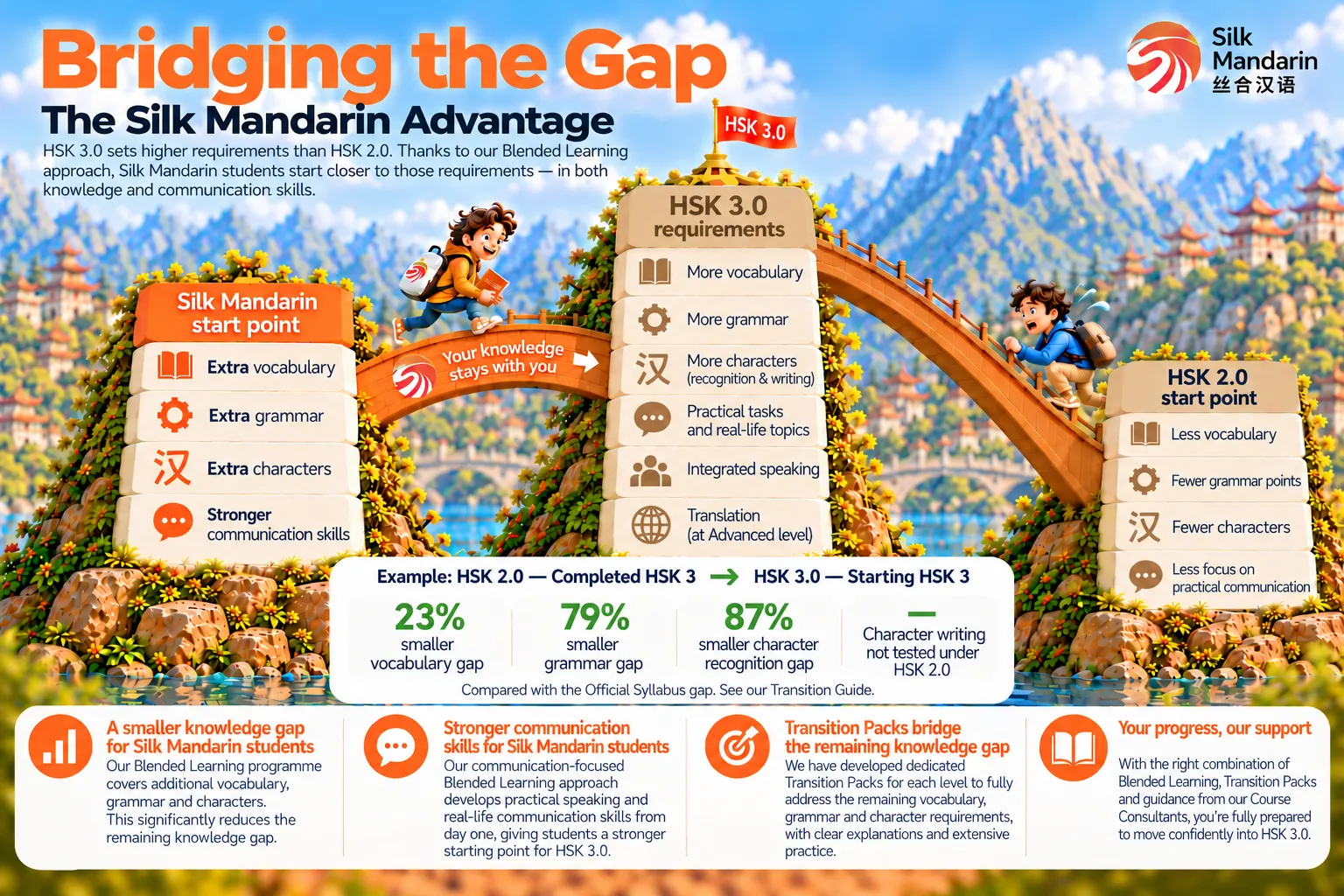
Bridging the Gap — The Silk Mandarin Advantage
Frequently Asked Questions About HSK 3.0
1 . Is HSK 3.0 harder than HSK 2.0?
2 . Can I Use HSK 3.0 for Independent Learning?
Find Your Way into HSK 3.0
Whether you are already studying HSK or just starting Chinese, the right learning path depends on your current knowledge and what you want to achieve.
Silk Mandarin’s involvement in the development of the new HSK 3.0 learning materials, combined with our experience in Blended Learning, enables our team to help you identify a suitable starting level and plan your next steps.