💡 Key Takeaways
Learning Mandarin can be incredibly rewarding. But many learners lose confidence early on. They struggle with pronunciation, tones, unfamiliar grammar and Chinese characters — often all at the same time.
This can quickly create the feeling that Mandarin is simply too difficult. But there is another way to look at it. At Silk Mandarin, we often say:
Mandarin is not so much difficult as it is different.
It is very different from Western languages in several important ways. And when those differences are taught in the same way as a Western language, Mandarin can become unnecessarily difficult.
The challenge, therefore, is not only what you need to learn. It is also how — and in what order — you learn it.
When people think about Mandarin pronunciation, they usually think first about tones. But there is an important challenge even before tones enter the picture.
Mandarin contains sounds that do not exist in many Western languages. Pinyin uses the Roman alphabet to represent Mandarin pronunciation, but familiar-looking letters do not always represent familiar sounds.
A beginner may therefore read Pinyin, think they are pronouncing a word correctly, and still produce a very different sound.
This matters because pronunciation habits form quickly. Once an incorrect sound becomes automatic, correcting it later can take considerable time and effort.
Good Mandarin pronunciation requires two things:
Videos and other digital tools are excellent for the first. A trained teacher remains essential for the second.
Then come the tones. Mandarin has four main tones plus a neutral tone. The same syllable pronounced with a different tone can have a completely different meaning. The classic beginner example is:
First
Tone
mā
妈
mother
Second
Tone
má
麻
hemp
Third
Tone
mǎ
马
horse
Fourth
Tone
mà
骂
to scold
Same basic sound. Different tones. Different meanings.
And tones do not exist in isolation. When words are combined into sentences, tones can influence each other and sometimes change. Learners therefore need to hear and practise tones not only as individual sounds, but also in real words and sentences.
Apps can help learners hear and repeat tones, but subtle pronunciation and tone mistakes are difficult for technology alone to correct reliably.
This is why pronunciation and tones need both repetition and real-time human feedback.
There is good news: Mandarin grammar is remarkably logical. But logical does not necessarily mean familiar.
Mandarin sentence structure works very differently from the grammar systems of languages such as English, Dutch, German, French or Spanish. Learners therefore often struggle not because Mandarin grammar is full of difficult rules, but because the logic is different from the logic they already know.
A common response is to teach students more and more grammar rules. That can make matters worse. Students may understand a rule when the teacher explains it, yet still be unable to build a sentence naturally when they start speaking. Too much class time is spent talking about grammar and too little time actually using Mandarin.
The real challenge is to help learners see the underlying logic and then practise it until correct sentence building starts to feel natural.
Chinese characters create another challenge. For a beginner, hundreds or thousands of unfamiliar symbols can look impossible to remember. Trying to memorise every character simply as a picture makes the problem even bigger.
Without a clear system, learners may:
But characters are not random drawings. They contain components, patterns and meaning. Once learners start to see this structure — and find ways of connecting characters to their own memory — character learning becomes much more manageable.
The problem is therefore not simply that Chinese has characters. It is how and when those characters are introduced and learned.
Language-learning apps can be very effective. For languages that are relatively close to a learner’s own language, they may even take you surprisingly far.
Mandarin is different. As we have seen, Mandarin presents several challenges that are particularly difficult to master through an app alone:
An app can provide excellent input. It can demonstrate sounds, introduce vocabulary, explain grammar and provide unlimited opportunities for repetition.
But it cannot reliably hear everything a trained Mandarin teacher hears — or respond to a learner in the same flexible and personal way.
This distinction is especially important at beginner level. If pronunciation and tone mistakes go unnoticed, they can quickly become habits. And once those habits are established, they are much harder to correct.
So for Mandarin, the most effective question is not:
“Can technology replace the teacher?”
It is:
“How can technology and teachers each do what they do best — and reinforce each other?”
There is one more problem that is easy to underestimate. A beginner is often expected to learn:
pronunciation + tones + vocabulary + grammar + characters
all at the same time. That is a lot. Even with a good learning method, trying to give equal attention to everything from day one can quickly become overwhelming.
A better approach is to build Mandarin step by step, giving learners time to create a strong foundation before shifting more attention to the next challenge.
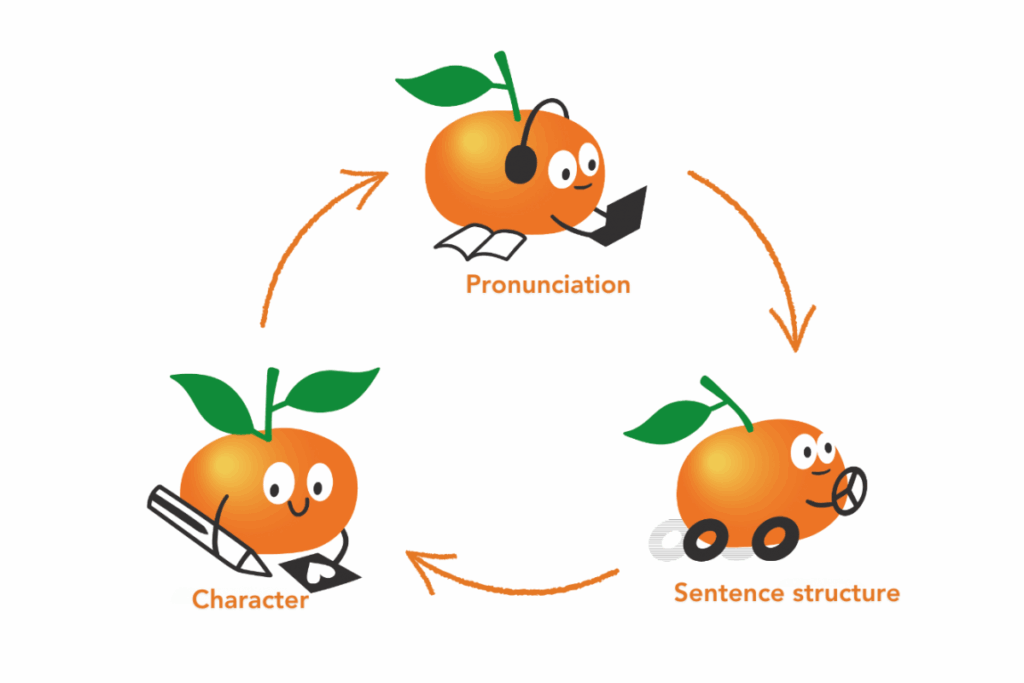
Pronunciation and tones can come first. Sentence building can become a stronger focus once learners have developed some vocabulary and a sound foundation. Characters can gradually take a more central role as learners move towards higher levels.
We will return to this important idea later, because learning Mandarin efficiently is not only about choosing the right method — it is also about learning the right things at the right time.
Put all these challenges together and it becomes easier to understand why so many learners struggle. They may be trying to:
often within the same traditional classroom format.
The answer is not necessarily to study harder. It is to organise the learning process better.
Research into learning and language acquisition points towards several useful principles: repeated exposure over time, preparation before active practice, frequent retrieval and output, immediate feedback, and regular review.
These principles can benefit Mandarin learners with very different backgrounds, goals and schedules. What changes is the content, pace and level — not the basic way in which effective learning works.
This brings us to the central question of this article:
Can we combine independent learning and teacher-led learning in a way that makes Mandarin more efficient, structured and manageable?
That is exactly the idea behind Blended Learning.
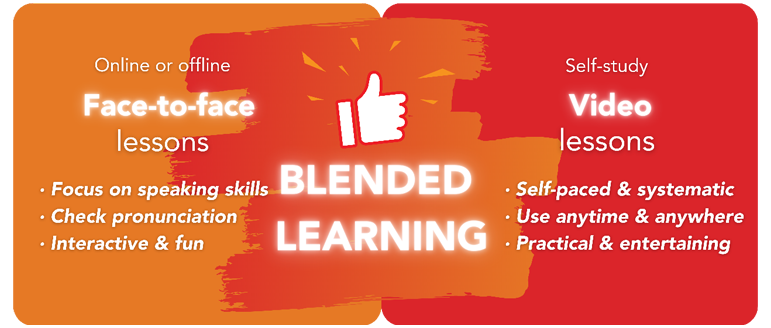
Blended Learning is sometimes described simply as a combination of online learning and classroom teaching. But that misses the most important point.
Blended Learning is:
A thoughtful integration of teacher-led classes with modern digital learning tools.
The key is not the technology itself. It is deciding parts of the learning process are best done independently and which benefit most from interaction with a teacher and other learners.
When these two approaches are designed to reinforce each other, the whole becomes more than the sum of its parts.
Digital learning tools are particularly good at things learners can do independently:
A live class is good at very different things:
Blended Learning brings these strengths together instead of asking one learning format to do everything.
This is especially valuable for Mandarin. As we saw in Chapter 1, learners need both repeated exposure to unfamiliar sounds, tones, vocabulary and structures and real-time human feedback and communication.
At Silk Mandarin, we organise Blended Learning around three simple steps:
Before class, students use structured videos and digital learning materials to become familiar with the lesson goals, new vocabulary, grammar, characters, and other key language points. They can learn at their own pace, pause or repeat explanations when necessary, and arrive in class well prepared
The Classroom is where students turn what they have learned during Preview into active language use.
Because the core lesson content has already been introduced before class, valuable classroom time can focus on what benefits most from direct teacher involvement: interaction, speaking practice, guided application, correction, personalized feedback, and real communicative output.
After class, structured Review videos and exer‐cises help students revisit and practise the material and identify gaps in understand‐ing. This strengthens what they first encountered during Preview and then actively used in class.
The three parts are therefore not separate activities:
Simply adding videos to a traditional course does not make it Blended Learning.
Neither does:
For Blended Learning to work well, the different parts need to be designed as one learning system.
What students learn during Preview must prepare them for what happens in class. What happens in class must build on that preparation. And Review must reinforce what has already been learned and practised.
That integration is what makes the difference.
In a traditional class, a teacher often has to use valuable class time to explain new vocabulary, grammar or other new content while students listen.
Blended Learning moves much of this first learning outside the classroom. This creates an important shift:
For Mandarin learners, that means more time for speaking, interaction and correction — while still having the flexibility to learn and review new content at their own pace.
But why does this combination work so well? And why is it particularly effective for a language as different as Mandarin?
That is what we will explore in the next chapter: the Silk Mandarin Blended Learning system, how it works, and why it works.
Chapter 2 introduced the basic idea behind Blended Learning: combine independent digital learning with teacher-led classes so that each does what it does best.
At Silk Mandarin, we have built our Mandarin curriculum around this principle.
The basic learning cycle is simple:
Preview
Class
Review
But the strength of the system comes from what happens within each step — and how the three steps reinforce each other.
In a traditional classroom, students often encounter new vocabulary, grammar and other new content for the first time while the teacher is explaining it.
That creates two problems. Students have to understand new information immediately, and much of the valuable class time is spent listening rather than using Mandarin.
With Silk Mandarin’s Blended Learning system, new content is learned before class.
Depending on the level, students use our video-based learning materials to prepare:
Students can watch at their own pace. They can pause, rewind and repeat difficult parts as often as necessary. This means they arrive in class already familiar with what they are going to practise.
Preview is not extra homework added to the course. It is the first step of the learning process.
Once the initial explanation has moved to Preview, something important happens:
class time becomes available for communication.
A typical 90-minute Silk Mandarin class includes:
Instead of spending most of the class listening to explanations, students actively use what they prepared. They speak. They make mistakes. They receive correction. They try again.
This is particularly important in Mandarin. A learner may understand intellectually how a tone should sound or how a sentence should be structured, but understanding something is not the same as being able to produce it correctly in real communication.
That is where the teacher becomes essential — a point we will explore further in Chapter 4.
Classes are also recorded, so students can return to important explanations, corrections or practice moments afterwards.
Understanding something once does not mean you have learned it. Without reinforcement, new vocabulary, sentence structures, pronunciation patterns and characters can disappear surprisingly quickly. Review therefore forms the third part of the cycle.
After class, students revisit what they have learned through activities such as:
Review is not simply repetition for the sake of repetition. It gives the brain another opportunity to retrieve and strengthen information after it has already been encountered during Preview and actively used during class.
The cycle is simple: students first understand the material during Preview, actively use it in Class, and strengthen it through Review. Then the cycle starts again with the next class.
The three steps of Blended Learning — Preview → Class → Review — are simple, but together they bring several well-established principles of effective learning into practice.
Priming — Familiarity Before Practice
When students encounter new material during Preview, they create a first mental framework. When the same vocabulary, sounds or sentence structures appear in class, they are no longer completely new. Students recognise them and can focus more attention on actually using them. This reduces cognitive load and makes participation easier.
Spaced Repetition — Meeting the Same Material Again
Learning becomes more durable when the same material is revisited over time rather than learned in one intensive session. In Silk Mandarin’s Blended Learning cycle, students encounter, use and retrieve the same material at different moments.
The BL steps naturally creates this spacing:
First exposure
Active use
Retrieve & reinforce
Students encounter important material several times, in different ways and at different moments.
Active Output — Learning by Using Mandarin
Watching and listening are important, but language ultimately needs to be produced. During class, learners have to retrieve words and sentence structures from memory and use them to communicate.
This active output helps turn passive knowledge — “I recognise this” — into usable knowledge — “I can actually say this.”
Listening Before Speaking
This is particularly important for Mandarin. Before learners can reproduce unfamiliar sounds and tones accurately, they first need to hear them clearly and repeatedly.
Preview provides that repeated input. Class then provides the opportunity to produce the sounds and receive immediate correction.
Multiple Ways of Learning
Students do not encounter new content in only one form. They may:
Using different learning channels helps strengthen understanding and memory. Together, these principles explain why the three stages work better as a cycle than as separate learning activities.
Blended Learning can be used for many subjects and languages. But several characteristics of Mandarin make the approach particularly useful.
Pronunciation and tones require repeated listening as well as real-time correction.
Grammar is logical but very different from Western grammar, so learners benefit from first understanding the structure at their own pace and then applying it through speaking.
Vocabulary needs repeated exposure and active use before it becomes readily available in conversation.
Characters require regular exposure and reinforcement rather than one-time memorisation.
BL creates room for all of these activities without asking the teacher to squeeze explanation, practice, correction and review into the same class. But there is still an important question. Even with an efficient Blended Learning system, a beginner may think:
“I still need to learn pronunciation and tones, grammar, vocabulary and Chinese characters. Isn’t that simply too much to learn at the same time?”
The answer is: it can be.
And this is where the order in which you learn Mandarin becomes just as important as the learning method itself.
One of the most common mistakes in Mandarin teaching is trying to give beginners everything at once.
Pronunciation. Tones. Vocabulary. Grammar rules. Characters.
Even a good learning method cannot completely solve the overload created by a poorly structured curriculum.
At Silk Mandarin, we therefore shift the main learning focus gradually.
First: Pronunciation & Tones — Practice Pinyin + HSK 1
At the beginning, pronunciation and tones deserve the greatest attention.
You cannot start working on them too early. Correct sounds and tones form the foundation of spoken Mandarin, while incorrect habits become increasingly difficult to change later.
That is why we combine HSK 1 with our Practice Pinyin video series, giving learners substantial time to listen, practise and receive correction.
Meanwhile, HSK 1 introduces useful vocabulary and just enough basic grammar to start making simple sentences. Learners also get their first introduction to simple characters.
But the main focus remains clear:
build a strong pronunciation and tone foundation first.
Next: Sentence Building — Grasp Grammar + HSK 2
By the time learners move into HSK 2, they have spent considerable time working on pronunciation and tones and have already built a useful base of vocabulary.
Now another question becomes more important:
How do I put the words I know in the right order and build correct Mandarin sentences?
HSK 2 introduces much more grammar, making this the natural stage to shift more attention towards sentence building.
For this, Silk Mandarin developed the Grasp Grammar video series, based on our Slow Motion Technique.
Instead of overwhelming learners with rule after rule, the Slow Motion Technique helps them understand Mandarin sentence structure through one simple underlying rule.
Because pronunciation and tones are already more stable, learners now have more mental space to concentrate on how Mandarin sentences work.
Then: Characters — Hack Hanzi + HSK 3
Characters are introduced earlier, but they become increasingly important as learners progress.
The further you go in Mandarin, the more you realise that characters are not simply an extra skill. They are at the heart of the language and essential for reaching higher levels.
HSK 3 is therefore the natural stage to make characters a much stronger focus. Learners now have a better foundation in pronunciation, tones, vocabulary and sentence building, and HSK 3 increasingly requires them to work directly with Hanzi rather than relying on Pinyin.
Our Hack Hanzi video series helps learners approach characters through their components, structure, logic and personal memory associations rather than simply memorising them as shapes. At the same time, Hack Hanzi encourages a personal approach to character learning. It provides useful techniques and guidance while giving you the freedom to create your own associations and discover which memorisation methods work best for you. The result is a more logical, flexible and engaging way to learn characters.
The timing matters. Learners are not trying to master pronunciation, sentence building and characters all at full intensity at the same time. Their attention can gradually shift towards the next major challenge.
The Principle: Build Mandarin Step by Step
Learners are not expected to master pronunciation, sentence building and characters at full intensity at the same time. Instead, the main learning focus shifts gradually as their Mandarin develops.
Not everything at once:
Pronunciation & Tones + Sentence Building + Characters
Instead, the main focus shifts gradually:
Pronunciation & Tones
Sentence Building
Characters
Vocabulary and communication develop throughout all three stages. Basic grammar and characters also appear from the beginning. What changes is where the main learning focus lies.
This distinction is important:
Blended Learning makes each stage more efficient.
A balanced curriculum prevents learners from becoming overwhelmed.
Together, they make Mandarin much more manageable.
When Blended Learning and a balanced curriculum work together, learners experience four important benefits:
Faster, More Effective Learning
Students learn new content before class, spend more class time actually speaking Mandarin, and reinforce what they have learned afterwards. Less valuable class time is lost to explanations.
Better Mandarin
Repeated listening, teacher correction and active practice lead to better pronunciation and tones, clearer sentence building and stronger long-term retention.
Less Overload, More Confidence
Learners do not have to master pronunciation, grammar and characters all at once. The main focus shifts gradually as their Mandarin develops, making progress feel manageable and achievable.
More Flexibility and Motivation
Preview and Review can fit around busy schedules, while the clear learning routine provides structure and momentum. Students know what to do, see their progress and are more likely to keep going.
The system also creates a simple rhythm around every class. As a general guideline:
This rhythm creates structure without removing flexibility. Students know how much time to set aside before, during and after each class.
Times are approximate and depend on the course, level and learner.
Blended Learning uses technology to make learning more flexible and efficient. But that does not make the teacher less important.
For Mandarin, the opposite is true.
By moving explanations and first exposure to Preview, Blended Learning frees the teacher from spending large parts of the class presenting new material. The teacher can focus instead on the things that are difficult — or impossible — to learn alone.
Blended Learning does not make the teacher less important. Quite the opposite: it makes the teacher’s role even more valuable. By moving explanations to Preview, teachers can focus on what only they can truly provide: real interaction, immediate correction, personalised guidance and motivation.
In a traditional class, teachers often spend a large amount of time explaining vocabulary, grammar, pronunciation or other new content.
In Blended Learning, much of that first learning has already happened during Preview. This changes the role of the teacher. Instead of mainly explaining, the teacher can focus on:
The teacher becomes less of a lecturer and more of a coach and guide. And for language learning, that is exactly where a teacher can add the most value.
This is particularly important in Mandarin. A learner may listen to a pronunciation example many times and still not hear that their own pronunciation is slightly wrong. The same applies to tones.
A trained Mandarin teacher can hear these differences immediately, creating a continuous correction cycle:
Listen
Correct
Try again
Improve
This real-time feedback helps learners correct mistakes before they become habits.
The teacher can also identify patterns that an individual learner may not notice. The problem may not be one particular word, but a sound the student consistently pronounces incorrectly. Or a tone may be correct in isolation but change when the student starts speaking in full sentences.
This kind of correction is one of the main reasons why combining digital learning with teacher-led practice works so well for Mandarin.
Knowing vocabulary and understanding grammar does not automatically mean you can speak Mandarin. Real communication requires you to listen, understand, choose the right words, build a sentence and respond — often within seconds.
That can only be developed by actually communicating.
The teacher helps students move gradually from simple, structured practice towards more natural conversation. They can ask follow-up questions, change a situation, challenge a student to say something differently or help them when they get stuck.
This turns knowledge learned during Preview into Mandarin that students can actually use. And because the teacher responds to what the learner says, no two conversations are exactly the same.
There is another part of language learning that technology cannot easily reproduce: the human experience of learning together.
A good teacher notices when a student is struggling, when something needs another explanation, or when someone is ready for a bigger challenge.
They can adapt examples to the learner, encourage someone who is hesitant to speak and turn mistakes into useful learning moments.
But classes should also simply be enjoyable.
A good Mandarin class includes interaction, humour, shared experiences and laughter. Students communicate with real people rather than simply completing exercises on a screen.
That matters because learning Mandarin takes time. Students who enjoy their classes are more likely to participate, stay motivated and keep learning.
Blended Learning does not make the teacher less important. It allows technology and teachers to focus on what each does best.
Technology can provide clear explanations, repetition, flexibility and self-paced practice. Teachers add what technology cannot replace: real-time interaction, immediate correction, personalised guidance and human motivation.
Use technology for what technology does well. Use teachers for what people do well.
That is why the teacher remains the human heart of Blended Learning – and why better technology can actually make great teaching even more valuable.
So what does Blended Learning actually look like when you start learning Mandarin?
The first four weeks of an HSK 1 Intensive 30 course provide a good example. Students combine:
At this stage, the main focus is deliberately on pronunciation and tones, while students gradually build vocabulary, learn basic sentence structures and get their first introduction to Chinese characters.
The goal is not to learn everything at once. It is to build a strong foundation, step by step.
The first priority is pronunciation.
During Preview, students become familiar with Mandarin sounds, Pinyin and the four tones. They also start learning their first useful words and simple sentence patterns.
Because they have already heard and practised the sounds before class, the teacher can immediately focus on helping them produce those sounds correctly.
In class, students begin speaking from the start through simple introductions and short exchanges. The teacher listens carefully and corrects pronunciation and tones in real time.
By the end of the first week, students typically:
understand the basic Pinyin and tone system
understand the basic Pinyin and tone system
recognise and produce their first basic sentence patterns
feel much less intimidated by Mandarin pronunciation
The important result is not perfection. It is that students have started building the right habits from the beginning.
In the second week, pronunciation and tones remain an important focus, but students now have more vocabulary to work with.
Preview introduces new words, basic grammar patterns and short dialogues. Students hear how familiar sounds and tones behave when they become part of real sentences.
Class time is increasingly used for short question-and-answer exchanges and practical dialogues.
The teacher continues to correct pronunciation and tones, but students are now also learning to retrieve vocabulary and build sentences while speaking.
By the end of Week 2, students typically:
handle simple questions and answers
use a growing range of vocabulary
speak with greater confidence
become more consistent with pronunciation and tones
Just as importantly, Preview → Class → Review is beginning to feel like a natural learning routine.
By Week 3, students are no longer concentrating on individual sounds alone.
They begin combining vocabulary and basic sentence structures more freely in practical situations: introducing people, ordering something, asking simple questions or exchanging basic information.
The class becomes increasingly communicative.
The teacher can expand a student’s answer, ask a follow-up question or turn a simple sentence into a short dialogue. Pronunciation and tone correction continue throughout, but now within increasingly natural speech.
Students also continue to encounter simple characters, without characters becoming the main learning focus yet.
Typical progress includes:
longer and more natural beginner exchanges
better listening comprehension
faster recall of vocabulary
more stable pronunciation and tones
growing confidence in building simple sentences
Students start experiencing an important shift: they are no longer simply learning Mandarin — they are beginning to use it.
By the fourth week, students have repeatedly moved through the Preview, Class and Review cycle. They know how to prepare, what to expect in class and how to reinforce what they have learned afterwards.
Their vocabulary has grown. Basic sentence patterns are becoming more familiar. Pronunciation and tones are more stable, and students can handle a growing number of simple everyday situations.
Most importantly, they have developed a foundation on which they can continue building.
By the end of the first four weeks, students typically:
communicate in a range of simple everyday situations
understand and use basic Mandarin sentence structures
hear and produce tones more accurately
recognise a first set of Chinese characters
feel comfortable speaking even when they make mistakes
have developed a clear and sustainable study routine
Four weeks will not make anyone fluent in Mandarin — and that is not the promise.
What those first weeks can do is something more important: show learners that Mandarin is manageable.
They have started with the most important foundation: pronunciation and tones. At the same time, they have built useful vocabulary, started forming sentences and become familiar with their first characters.
As they progress, the emphasis will gradually shift. HSK 2 will bring sentence building and grammar more strongly into focus, supported by Grasp Grammar and the Slow Motion Technique. Later, HSK 3 will place much greater emphasis on characters, supported by Hack Hanzi.
So the first four weeks demonstrate the same principle that runs through the entire Silk Mandarin curriculum:
Do not try to master everything at once. Build the right foundation first, and then add the next layer.
Combined with the Preview → Class → Review cycle, this makes progress structured, visible and achievable.
Mandarin is different from Western languages. Learners need to master unfamiliar sounds and tones, a different sentence structure, and eventually a completely different writing system. That can feel overwhelming, especially when everything is introduced at the same time.
But learning Mandarin does not have to work that way.
Blended Learning creates a more efficient learning process by combining independent digital learning with teacher-led classes. Students learn new content at their own pace during Preview, actively apply it in Class, and reinforce it through Review.
But Blended Learning is only part of the answer. At Silk Mandarin, we combine it with a balanced curriculum in which the main learning focus gradually shifts from Pronunciation & Tones to Sentence Building and then to Characters.
This allows learners to concentrate on the right challenge at the right stage instead of trying to master everything at once.
Silk Mandarin brings these elements together in one learning system.
The Three Steps of Blended Learning
Preview
Learn new content
Class
Apply, speak and get corrected
Review
Reinforce and remember
The Development of the Main Learning Focus
Dedicated Learning Tool:
Pronunciation & Tones
Practice Pinyin
Sentence Building
Grasp Grammar + SMT
Characters
Hack Hanzi
The three learning tools directly support the different areas of learning as the main focus develops. Practice Pinyin builds a strong pronunciation and tone foundation. Grasp Grammar and Slow Motion Technique help learners understand the logic of Mandarin sentence structure and quickly learn to build their own sentences. Hack Hanzi helps learners understand and remember Chinese characters through structure, logic and personal associations.
These are not separate add-ons. They are integrated into a curriculum designed around what learners need most at each stage.
Throughout this process, technology and teachers each have a clear role.
Digital learning provides clarity, repetition, consistency and flexibility.
Teachers provide correction, communication, personalisation, motivation and human interaction.
Neither replaces the other. Together, they create a learning experience that is more efficient than either could provide alone.
The goal is not to make Mandarin artificially easy. Learning a language requires time, practice and persistence.
The goal is to make that effort better structured and more effective: learn the right things at the right time, use class time for what requires human interaction, and reinforce what you have learned so that it lasts.
At Silk Mandarin, we like to say: “Mandarin is not so much difficult as it is different.” And when you learn those differences in the right way, step by step, Mandarin becomes manageable.
We use cookies to improve your experience on our site. By using our site, you consent to cookies.
Websites store cookies to enhance functionality and personalise your experience. You can manage your preferences, but blocking some cookies may impact site performance and services.
Essential cookies enable basic functions and are necessary for the proper function of the website.
Statistics cookies collect information anonymously. This information helps us understand how visitors use our website.
Google Analytics is a powerful tool that tracks and analyzes website traffic for informed marketing decisions.
Service URL: policies.google.com (opens in a new window)
Clarity is a web analytics service that tracks and reports website traffic.
Service URL: clarity.microsoft.com (opens in a new window)
SourceBuster is used by WooCommerce for order attribution based on user source.
You can find more information in our Privacy Policy and Privacy Policy.