HITAM Jumat
4 pelajaran Mandarin langsung hanya dengan $9.90
|
Berlaku hingga November 30
Temukan penawarannya →
USD-$
En
Learning Mandarin on your own has never been more accessible. Videos, language apps, online courses and digital exercises allow you to study almost anywhere, at any time and at your own pace.
But access to learning resources does not automatically lead to successful learning. Many people start enthusiastically, download several apps, watch Chinese lessons on YouTube and begin memorising vocabulary. Yet after a few weeks, they may struggle to see real progress. They recognise words but cannot use them, understand grammar explanations but cannot build sentences, or lose track of what they should learn next.
The challenge is not finding more resources. It is knowing what to learn, in what order, how to practise and how to turn knowledge into usable Mandarin.
The good news is that much of Mandarin can be learned effectively through self-study. With a coherent learning programme, suitable learning techniques and consistent practice, you can make substantial progress independently. This guide explains how to organise your learning, overcome Mandarin’s particular challenges and develop the knowledge and skills needed to use Chinese with confidence.
💡 Pengambilan Kunci
Jawaban singkatnya adalah iya nih. You can learn a substantial amount of Mandarin independently, provided you follow an effective learning approach.
Self-study is particularly suitable for building vocabulary, understanding grammar, learning characters and developing listening, reading and writing skills. You can also practise pronunciation and speaking independently. However, understanding how Chinese works is not the same as being able to use it naturally in conversation.
Perbedaan antara knowledge and skill is important when considering both the possibilities and limitations of self-study.
Self-study offers considerable flexibility. You decide when and where to study, how quickly to progress and which areas deserve extra attention. It is accessible from almost anywhere, generally more affordable than regular teacher-led lessons, and allows you to adapt your learning activities to your personal preferences.
But learning independently also brings challenges. Without scheduled classes, it is easier to postpone studying. Without a clear curriculum, you may lose direction. And without feedback, mistakes can go unnoticed.
The greatest limitation concerns spontaneous communication. You can practise speaking aloud, record yourself and use digital conversation tools, but these do not fully reproduce the unpredictability of communicating with another person. Self-study is therefore a valuable learning option, provided you understand what you can achieve independently and where interaction adds value.
Successful self-study is not simply about studying longer or having exceptional discipline. It depends on four closely connected elements:
Together, these elements provide direction, continuity and measurable progress. Each has an important role, but a structured learning programme is particularly valuable because it connects what you learn today with what you have already learned and what comes next.
Before choosing your learning materials, ask yourself why you want to learn Mandarin. Perhaps you want to communicate with Chinese colleagues, manage everyday situations in China, prepare for an HSK examination or read Chinese texts.
A clear goal helps you decide what to learn, how much time to invest and how to measure progress. Break larger ambitions into manageable objectives, such as introducing yourself, ordering food or describing your daily routine. As your Mandarin improves, these smaller goals gradually become more ambitious.
This is one of the most important requirements for successful self-study — and one that is often underestimated.
Having access to good explanations, useful apps and engaging videos does not necessarily mean you have a good learning programme. What matters is whether the materials form a jalur pembelajaran yang koheren, with a logical sequence and clear connections between the different parts of the language.
Good self-study materials should offer four essential features:
For example, vocabulary introduced in one lesson should reappear in grammar examples, listening exercises and practical sentences. New grammar patterns should build on structures you already understand, while exercises should gradually challenge you to use what you have learned more independently.
A well-structured programme also prevents unnecessary cognitive overload. Instead of confronting you with too many unfamiliar elements at once, it introduces new material in a manageable sequence while regularly reinforcing earlier learning.
Yang paling penting, you should always know where you are in your learning journey, what you have already learned and what comes next. This gives you direction and makes progress easier to recognise.
Attending classes naturally creates a learning rhythm. You have scheduled lessons, preparation to complete and a teacher expecting you to participate. With self-study, you need to create that structure yourself. Motivation may get you started, but consistent habits are what keep you progressing.
Choose a realistic schedule and try to study at a regular time. For many learners, 20–45 minutes on most days is more sustainable than one long weekly session. Connecting study to an existing routine, such as breakfast or your lunch break, can make it easier to maintain. On busy days, even a short review session helps preserve continuity.
The goal is not to study perfectly every day, but to make Mandarin learning a regular part of your life. A sustainable routine is more valuable than an ambitious schedule you cannot maintain.
Watching a video or reading an explanation helps you understand new material, but understanding alone is not enough. To make knowledge available when you need it, you must actively retrieve and use what you have learned.
For example, after studying a new sentence pattern, try constructing several sentences of your own without looking at the explanation. Say them aloud, not just in your head. Or, after learning vocabulary about food, imagine ordering a meal: describe what you want, ask a question and respond to a possible answer.
Another useful exercise is to listen to a short Chinese question, pause the recording and answer aloud before hearing the model response. This forces you to retrieve vocabulary, construct a sentence and practise pronunciation at the same time.
Regular review strengthens these abilities. Revisiting vocabulary, grammar and characters over time makes them easier to remember and use, especially when you practise them in different contexts.
Don’t just recognise what you have learned. Practise recalling, producing and using it.
The general principles of successful self-study apply to any language. However, Mandarin presents some particular challenges. At Silk Mandarin, our students consistently identify three areas as their biggest challenges: pronunciation and tones, grammar and sentence structure, and Chinese characters.
These challenges do not necessarily make Mandarin more difficult than other languages. In many ways, Mandarin is simply different from what learners are familiar with. Understanding these differences — and using suitable learning techniques — can make studying considerably more manageable.
Pronunciation and Tones — Build a Strong Foundation
Mandarin uses sounds and four main lexical tones that may be unfamiliar to learners of European languages. A change in tone can change the meaning of a word, making accurate pronunciation essential.
Pinyin, the romanisation system for Mandarin, helps learners understand how Chinese syllables are pronounced. However, Pinyin uses familiar letters to represent sounds that are sometimes quite different from those associated with the same letters in English or other European languages. The written Pinyin spelling alone cannot fully convey how every Mandarin sound should be produced. Listening carefully to accurate pronunciation models and learning how the sounds are formed are therefore essential.
Learning Pinyin, recognising tones and practising pronunciation are well suited to self-study. Repetition, listening exercises and recording yourself can all help. However, recognising a sound and producing it correctly are different abilities, which is why feedback remains particularly valuable.
Vocabulary — Build Your Chinese Step by Step
Vocabulary is essential for understanding and expressing meaning, but memorising isolated words is not enough. Learn vocabulary in meaningful contexts, preferably with audio and example sentences, and practise recalling words without looking at them.
Vocabulary becomes much more useful when combined with grammar. Instead of simply memorising words, learn how to put them together into practical sentences. This helps you develop communication skills from the beginning.
Grammar — Different, Not Difficult
Mandarin grammar is often more straightforward than learners expect. Chinese verbs do not change according to person or tense in the way they do in many European languages, and there are no grammatical genders.
The main challenge lies in understanding different sentence structures and word order. Rather than translating word for word from your native language, you need to understand how Chinese sentences are built.
With clear explanations and a systematic sentence-building approach, Mandarin grammar becomes much more logical. Once you understand the underlying patterns, you can begin constructing your own sentences quickly instead of memorising countless complete expressions.
Chinese Characters and Writing — Learn Logically and in Your Own Way
Chinese characters may initially appear intimidating, but they are not random collections of strokes. Many contain recurring components that provide clues about meaning or pronunciation.
Understanding these structures, together with logical connections and personal associations, makes characters easier to remember. Rather than relying entirely on repetitive copying, you can learn to recognise how characters are constructed and develop memory techniques that work for you.
It also helps to distinguish between recognising characters, typing Chinese and writing characters by hand. These are related but different abilities, and the amount of practice you devote to each may depend on your learning goals.
Listening — Recognising Spoken Mandarin
Spoken Mandarin can initially sound like a continuous stream of unfamiliar sounds, even when you already know some of the vocabulary. Develop listening skills through repeated exposure to audio appropriate to your level, starting with short recordings and gradually increasing the complexity.
Listening materials that reinforce vocabulary and grammar you have already studied are particularly useful because they help connect individual language elements into meaningful communication.
Speaking — Turning Knowledge into Communication
Speaking brings several skills together: recalling vocabulary, constructing sentences, pronouncing words correctly and responding to another person.
You can practise many of these independently through repetition, recordings, spoken exercises and simulated conversations. But real conversations introduce unexpected questions, different speaking styles and the need to respond spontaneously. That is why interaction and feedback are particularly valuable for developing confident communication.
Different Mandarin skills benefit from different forms of practice.
| Area pembelajaran | Belajar sendiri | Interaction and feedback |
|---|---|---|
| Pronunciation & tones | Learn sounds and practise production | Identify and correct mistakes |
| Vocabulary & grammar | Learn words, patterns and sentence construction | Apply them spontaneously |
| Characters & writing | Recognise, understand, type and write characters | Clarify difficulties and receive correction |
| Reading & listening | Develop comprehension through structured materials | Encounter different speakers and interpretations |
| Berbicara | Rehearse sentences and practise responses aloud | Develop spontaneous communication and confidence |
The conclusion is not that some skills can only be learned with a teacher. Rather, different learning activities benefit from different forms of practice. Much of Mandarin can be learned independently, while real interaction helps turn that knowledge into practical communication skills.
Once you understand what effective self-study requires, the next question is practical: How should you organise your learning to make steady progress?
Two principles are particularly important: follow a logical learning sequence and make active practice part of every study session.
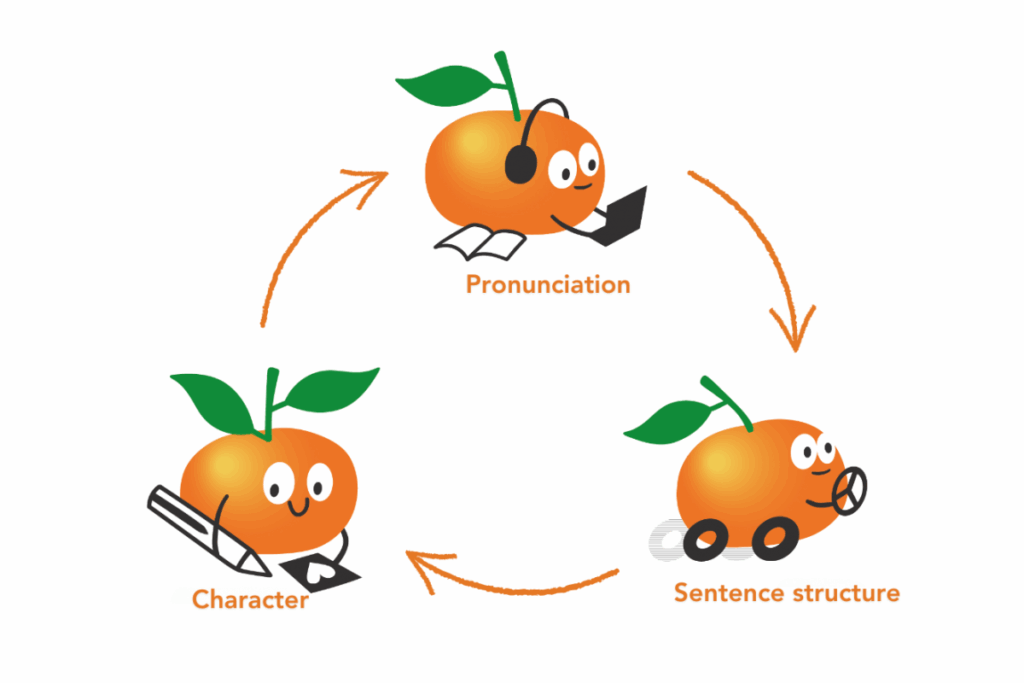
As discussed in Chapter 3, Silk Mandarin students consistently identify three major challenges: pronunciation and tones, grammar and sentence structure, and Chinese characters. All three require attention, but trying to master them simultaneously can lead to cognitive overload.
A more effective approach is to tackle these challenges step by step, gradually shifting the main learning focus as your Mandarin develops.
First, establish a strong pronunciation and tone foundation.
Learning Pinyin and developing accurate pronunciation early makes vocabulary learning, listening and speaking easier.
Next, focus increasingly on grammar and sentence construction.
Learn how Chinese sentences are built and combine new grammar patterns with useful vocabulary to construct practical sentences.
As your foundation develops, give Chinese characters increasing attention.
Learn their structures and components, develop personal memorisation techniques and practise reading and writing according to your goals.
This does not mean learning these areas strictly one after another. Pronunciation, grammar and characters all appear from the beginning. What changes is where the main learning focus lies. Vocabulary and communication develop throughout, while listening, speaking, reading and writing receive appropriate practice at each stage.
This gradual approach helps prevent cognitive overload and makes Mandarin more manageable.
A practical self-study sequence is:
Learn → Understand → Practise → Retrieve → Use → Review
Start by learning and understanding a manageable amount of new material. Then practise through exercises, listening and speaking aloud. Try recalling words and constructing sentences without looking at the answers, and apply what you have learned by creating your own examples or responding to questions.
Review should also be part of your regular routine. It is often useful to begin a study session with a brief review of previous material before moving on to new content, and to finish by checking what you have understood and remembered.
Example: A 40-minute self-study session
| Aktivitas | Waktu |
|---|---|
| Review previous material | 5 min |
| Learn and understand new content | 10 min |
| Practise through exercises and speaking aloud | 10 min |
| Recall vocabulary and construct sentences aloud | 10 min |
| Check understanding and plan the next session | 5 min |
This is only an example. The ideal balance depends on your level, learning objectives, materials and personal preferences. Some learners prefer shorter, more frequent sessions, while others work better with longer periods of focused study. Both can be effective if your learning remains structured, active and consistent.
This independent learning process is also closely related to Silk Mandarin’s Blended Learning approach, which we explain in Chapter 5. The difference is that Blended Learning combines independent preparation with live teacher-led classes.
There are many useful Mandarin learning tools, including vocabulary apps, flashcards, online courses, videos, character-writing tools and AI conversation platforms. Some modern apps offer comprehensive programmes covering multiple language skills, with personalised review and speaking practice.
So the question is not simply how many functions an app provides. The real question is how well those functions fit together within a coherent learning programme.
For example, which vocabulary and grammar should you learn first, and how are they combined into useful sentences? How do pronunciation, grammar and characters develop together without overwhelming you? Do exercises progress from understanding toward active use? And how do you know when to review previous material or move on?
A good programme should provide clear answers. Rather than collecting numerous unrelated resources, it is usually better to choose one structured programme as your foundation and use additional tools where they add value.
Several common mistakes can slow down your progress.
Using too many unrelated resources.
Moving between apps, platforms, books and videos can lead to fragmented learning, repetition of some topics and gaps in others. Without a clear learning path, it becomes difficult to know what comes next.
Trying to learn everything at once.
Giving pronunciation, grammar, vocabulary and characters equal intensity from the beginning can cause cognitive overload. Follow a gradual progression instead.
Watching instead of practising.
Understanding explanations is only the first step. Pause, repeat, answer questions and produce your own sentences aloud.
Neglecting pronunciation and tones.
Incorrect pronunciation habits can become difficult to change. Practise from the beginning and seek feedback when possible.
Memorising without understanding.
Isolated word lists, word-for-word translation and repetitive character copying are less effective when disconnected from meaning and structure.
Reviewing too little.
Constantly moving to new lessons without revisiting earlier material leads to forgetting.
Relying on motivation rather than routine.
Choose a sustainable schedule instead of depending on occasional enthusiasm.
Completing lessons, watching videos and memorising vocabulary are useful milestones, but they do not tell the whole story. The more important question is: What can you actually do with what you have learned?
After studying a lesson about ordering food, for example, ask yourself:
These questions help you measure progress from recognition and understanding toward active recall, spoken production and practical use. A structured curriculum with clear objectives and regular assessments makes this easier.
Ultimately, progress is not just about how much Chinese you have studied, but what you can actually do with it.
Throughout this guide, one principle has appeared repeatedly: successful Mandarin self-study requires more than access to learning resources. It requires a structured learning system.
That is the thinking behind Silk Mandarin’s self-study learning materials, which combine a recognised curriculum with clear explanations, practice and dedicated techniques addressing the challenges our students most frequently encounter.
A Structured Learning Programme Based on HSK
Silk Mandarin’s self-study videos follow the HSK curriculum, providing a clear progression from one level and lesson to the next. The videos systematically explain the learning content, allowing students to study independently, repeat explanations and progress at their own pace.
Because the programme follows a defined curriculum, you always know where you are, what you have already learned and where your learning is heading. Vocabulary, grammar and other learning elements are introduced in a logical sequence rather than as unrelated topics.
Review activities help you check your understanding, practise what you have learned and identify areas that need further attention. Together, the videos and Review materials provide a coherent learning path without requiring you to assemble your own curriculum.
Three Dedicated Learning Tools for Mandarin’s Biggest Challenges
Based on the challenges our students consistently identify as their biggest difficulties, Silk Mandarin has developed three dedicated learning tools: Practice Pinyin, Grasp Grammar and Hack Hanzi. Each addresses one of these areas through an approach designed to make Mandarin easier to understand and master.
Practice Pinyin — Master Mandarin Pronunciation and Tones
Mandarin pronunciation involves much more than learning how to read Pinyin. Some sounds are unfamiliar, and the tones require careful listening and practice.
Practice Pinyin provides a comprehensive video-based approach to understanding and producing Mandarin sounds and tones. Through clear explanations, demonstrations and guided practice, you learn how the sounds are formed, how tones work and how to pronounce Chinese more accurately.
You can repeat the explanations and exercises as often as needed, building a strong pronunciation foundation at your own pace.
Grasp Grammar — Build Chinese Sentences Quickly with ONE Rule
Mandarin grammar is different, not difficult — especially when you understand how Chinese sentences are structured.
Grasp Grammar uses Silk Mandarin'S Slow Motion Technique (SMT) to explain Mandarin sentence construction through ONE fundamental rule. Rather than overwhelming learners with numerous disconnected grammar rules, SMT makes the logic of Chinese sentence structure clear and easy to follow.
By understanding how the building blocks fit together, you can quickly move beyond memorising complete sentences and start constructing your own. This makes grammar more logical, practical and immediately useful for communication.
Hack Hanzi — Understand, Remember and Enjoy Chinese Characters
Chinese characters may look complicated at first, but they become much more approachable once you understand how they are constructed.
Hack Hanzi explains character structures and recurring components, helping you recognise the logic behind characters rather than treating them as arbitrary shapes to memorise.
Through explanations, memory aids, examples and exercises, you develop a practical foundation for recognising, remembering and writing Chinese characters.
At the same time, Hack Hanzi encourages a personal approach to character learning. It provides useful techniques and guidance while giving you the freedom to create your own associations and discover which memorisation methods work best for you.
The result is a more logical, flexible and engaging way to learn characters.
Together, Practice Pinyin, Grasp Grammar and Hack Hanzi support Silk Mandarin’s gradual learning approach: building a strong pronunciation foundation, learning to construct sentences and developing character knowledge through structure and logic.
Silk Mandarin’s Self-Study and Blended Learning approaches share the same underlying learning principles. Both recognise that much of Mandarin can be learned effectively through structured independent study.
The difference is how that independent learning is combined with live interaction.
Self-Study — Learn Independently at Your Own Pace
With Self-Study, you follow the structured learning programme using videos, exercises and Review materials. You decide when to study, how much time to spend and when to revisit earlier lessons, while the curriculum provides the learning sequence.
Blended Learning — Combine Independent Learning with Live Classes
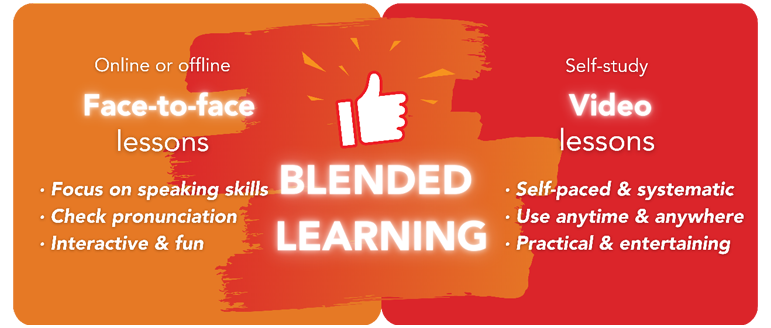
Blended Learning combines independent study with teacher-led lessons from the beginning, following three steps:
Pratinjau → Kelas → Ulasan
Selama Pratinjau, students learn new content independently through the learning videos. During Kelas, the teacher focuses primarily on speaking, interaction, pronunciation, feedback and practical application. During ULASAN, students consolidate what they have learned through further practice.
In other words, the independent learning that forms the basis of Self-Study also plays an essential role in Blended Learning. The live class adds structured opportunities to practise communication and receive personal feedback.
Pendekatan Mana yang Tepat untuk Anda?
Self-Study offers maximum flexibility and independence, making it suitable for learners who prefer managing their own schedule and progress. It can also provide an excellent head start for students who decide to move on to Blended Learning, allowing them to build a solid Mandarin foundation before joining live classes.
Blended Learning adds regular speaking opportunities, teacher feedback and a fixed learning rhythm. It is particularly valuable for learners who want to develop practical communication skills through frequent interaction.
Neither is a compulsory step toward the other. You can choose Blended Learning from your very first lesson or start with Self-Study and move to Blended Learning later.
Both approaches share the same principle: learn independently what you can learn effectively on your own, and make the best use of interaction when it is available.
Learning Mandarin independently can be effective, rewarding and flexible — provided you follow the right approach.
The essentials are clear: set meaningful goals, follow a structured learning programme, develop consistent habits and practise actively. Mandarin also benefits from suitable learning techniques that address the challenges students commonly encounter with pronunciation and tones, sentence structure and Chinese characters.
Above all, remember that learning is not just about understanding information. It is about developing the ability to retrieve and use what you have learned, including speaking Chinese aloud and applying it in practical situations.
Silk Mandarin supports this process through structured Self-Study materials and through Blended Learning, which combines independent study with live classes.
Whether you prefer to study independently or learn with a teacher from the beginning, choose a learning approach that is structured, practical and sustainable.
Learn Mandarin at your own pace — and choose the learning path that works for you.
Jelajahi Silk Mandarin’s Self-Study materials or discover how our Blended Learning approach combines independent learning with real communication practice.
Kami menggunakan cookie untuk meningkatkan pengalaman Anda di situs kami. Dengan menggunakan situs kami, Anda menyetujui penggunaan cookie.
Situs web menyimpan cookie untuk meningkatkan fungsionalitas dan mempersonalisasi pengalaman Anda. Anda dapat mengelola preferensi, tetapi memblokir beberapa cookie dapat memengaruhi kinerja dan layanan situs.
Cookies esensial memungkinkan fungsi dasar dan diperlukan untuk fungsi situs web yang tepat.
Cookie statistik mengumpulkan informasi secara anonim. Informasi ini membantu kami memahami bagaimana pengunjung menggunakan situs web kami.
Google Analytics adalah alat hebat yang melacak dan menganalisis lalu lintas situs web untuk keputusan pemasaran yang tepat.
URL layanan: kebijakan.google.com (terbuka di jendela baru)
Clarity adalah layanan analisis web yang melacak dan melaporkan lalu lintas situs web.
URL layanan: kejelasan.microsoft.com (terbuka di jendela baru)
SourceBuster digunakan oleh WooCommerce untuk atribusi pesanan berdasarkan sumber pengguna.
Anda dapat menemukan informasi lebih lanjut di Kebijakan Privasi ke Kebijakan Privasi.